

The Fibonacci numbers and the Platonic solids
<888> the 24 reduced Fibonacci numbers, when placed around a circle, visibly generate the shape of the 5 Platonic solids.
This time, I will take a closer look at how these strange phenomena occur.
In Euclidean geometry, the Platonic solids are regular, convex polyhedra. Their faces are congruent regular polygons, with the same number of faces meeting at each vertex. In classical thought, there are five solids that meet these criteria, each named according to its specific number of faces.

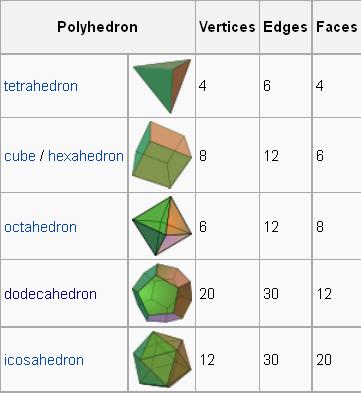
In his work 'Timaeus', written around 350 BC, Plato made a connection between these 5 polyhedra and the classical elements.
He equated the tetrahedron with the element of fire, the cube with Earth, the octahedron with air, the icosahedron with water, and the dodecahedron with quintessence, or the heavens and constellations.
In terms of its connection to Lurianic Kabbalah, Leonora Leet, in her book 'The Secret Doctrine of the Kabbalah', equates the 5 Platonic solids with the 'Partzufim'; the five faces of God: Arech Anpin, Abba, Imma, Z'eir Anpin, and Nukvah—the unmanifest, the father, the mother, the son, and the daughter. Since we have neither the time nor the space to examine this connection in depth, as it presents such a complex and detailed subject, perhaps it is best to leave it to you, the reader, to decide whether to investigate this apparent connection further.
The Tetrahedron.


The tetrahedron is the first manifested polyhedron, believed by Plato to correspond to the element of fire.
In our Fibonacci circle, it is generated by the interaction of the stellar configuration formed by 3, 6, and 9.
In Qabalistic thought, the tetrahedron is compelled to self-replicate into a star tetrahedron as the primary manifestation of duality. In the case of our device, this means it descends below and forms another tetrahedron from the remaining 3, 6, and 9.
The vertices of this emerging star tetrahedron provide all the points of manifestation for the next two solids, the cube and the octahedron, a pairing of solids that tend to manifest coterminously with one another.
The Cube.


The cube, equated with the element of Earth, is likewise, in its generation, a product of the 3-6-9 matrix. Its 6 faces provide for the manifestation of the third solid, the octahedron, whose vertices lie at the center points of the cube’s faces.
L'Octahedron.


L'Octahedron, with its classic connection to the element of Air, is also, like its partner the cube, generated by the same 3-6-9 pattern.
L'Icosahedron.


We now come to the final pairing, the icosahedron (Water) and the dodecahedron (Quintessence). These differ considerably from the previous solids, as they depend on a new pattern to manifest within the Fibonacci numbers. We now see another star come into play, one composed of groupings of the numbers 1-1-1 and 8-8-8, in order to provide the relevant energy pathways needed to generate these two solids. After studying Metatron’s Cube for some time to understand how these polyhedra emerged, it seemed to us that they did not manifest in a way that naturally fit the pattern - there simply were not enough coordinates within the merkabah / Metatron cube structure to fully account for their presence in this design. It was only when the reduced Fibonacci number pattern 24 was added to the Metatron cube in its 15-degree increments that it became clear these two solids were indeed integral components of the overall design.
The Dodecahedron.


The dodecahedron (Cosmos/Quintessence) sits comfortably within the matrix created by the 3-6-9 configuration and the 1-1-1/8-8-8 star.
- Choosing a selection results in a full page refresh.