

The menorah
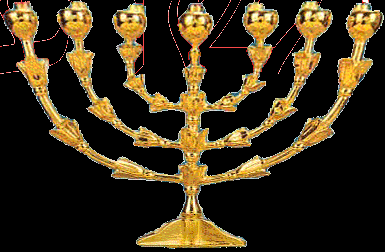
We will find this attribution through the 7-branched candelabrum, otherwise called:
MENORAH
introduction
31 You shall make a candelabrum of pure gold. The candelabrum, its base, and its shaft shall be hammered into shape. Its cups - buds and flowers - shall be one piece with it.
32 Six branches shall extend from its sides: three on one side and three on the other.
33 The first branch shall have three cups shaped like almond blossoms, with buds and flowers, and the second branch shall also have three cups shaped like almond blossoms, with buds and flowers. The same shall apply to the six branches extending from the candelabrum.
34 The candelabrum itself shall have four cups shaped like almond blossoms, with buds and flowers.
35 arranged as follows: one knob beneath the first two branches from the candelabrum; one beneath the next two; one beneath the last two: corresponding to the six branches extending from the candelabrum.
36 The knobs and branches shall be one piece with the candelabrum, and the whole shall be made from one block of pure gold, hammered into shape.
37 Make seven lamps for the candelabrum and arrange them so that they cast their light in front of it.
38 Its tongs and trays shall be of pure gold.
39 You shall use one talent of pure gold for the candelabrum and all its accessories.
40 See that you make them according to the pattern shown to you on the mountain.
Exodus XXV, 31-40
Looking at this candelabrum, “the menorah,” we can see that the number of almond blossoms is 22, the same as the number of letters in the Hebrew alphabet, and that their arrangement does not seem arbitrary. In fact, we will soon see that it is a key to discovering the cosmic significance of this alphabet.
Kabbalah (qabalah), once an oral and secret tradition, had to be written down to ensure its transmission. It still needed to be veiled. It is up to us to raise some of its sails.
Thus, it says that the 22 Hebrew letters are divided into three groups:
The mother letters, numbered 3. (3)
Double letters, numbered 7. (3 + 4)
Single letters, numbered 12. (3 + 4 + 5)
Total: 22
Thus designating the mother letters:
Aleph, Mem, and Shin
ש מ א
What the Kabbalists take “literally,” one might say.
However, this is a first veil, because we must read: א l שׁם, Sem (= name) Aleph (= 1), and understand:
Name of the One, that is, the Tetragrammaton, the 4-letter Name of God,
י ה ו ה
of which 3 are different: Yod, Hé, and Vaw. These three letters were in fact called “mothers of reading” to indicate the vowel sounds 'I', 'A', and 'O', respectively, before vowel points were used.
(Because when we say that Hebrew consists only of consonants, we lose sight of the fact that some letters are "semi-consonants" that can be pronounced as vowels.)
Conclusion: the 3 letters we will consider as mother letters are:
י ה ו and not א מ ש
And we will see later that this choice is justified for other reasons as well.
Thus, the written Kabbalah designates the double letters:
Taw Resh Peh Kaph Daleth Gimel Beth
ב ג ד כ פ ר ת
because they have a double consonant pronunciation, distinguished by the presence or absence of a diacritical dot called a 'dagesh.' For example: ב is pronounced 'V' while בּ is pronounced 'B'.
However, this is not the case with the letter Resh, whereas it is the case with the letter ש, which can be pronounced 'Ch': שׁ or 'S': שׂ
But since this letter had already been classified among the mothers, it obviously could not be considered a double letter; for this reason, we chose its neighbor: Resh
Conclusion: the 7 letters we will consider as double letters are:
ב ג ד כ פ ש ת
The single letters will be the remaining 12:
Aleph, Zayin, Heth, Teth, Lamed, Mem,
Nun, Samekh, Ayin, Tsadi, Qoph, Resh
א ז ח ט ל מ נ ס ע צ ק ר
It will now be necessary to find the corresponding positions of the letters in these three groups among the 22 flowers of the candlestick; this will be the subject of the following sections.
Continuing our observation of the menorah, we see:
- one flagship in each of the 3 branches,
- one terminal supports each of the 7 lamps,
- 12 other flowers arranged on the branches.
These numbers: 3, 7, and 12 obviously refer us to the 3 mother letters, the 7 double letters, and the 12 single letters.
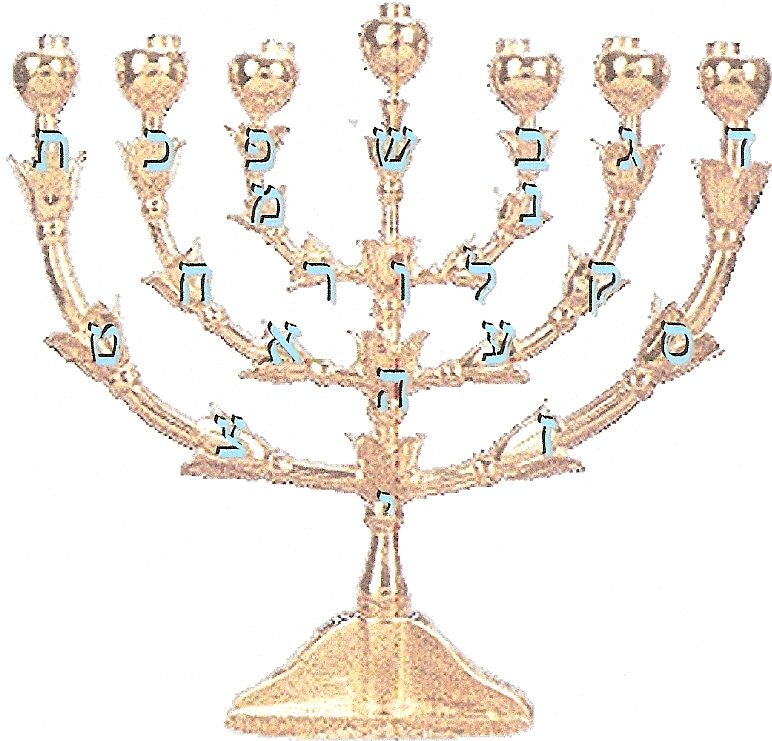
Layout of the mother letters: י ה ו
These constituent letters of the divine Name, called the Tetragrammaton, are attributed to the Persons of the Trinity:
The Father is attributed the Yod, the smallest of the letters, which represents a point (the point of origin);
the Hey, which means breath, is attributed to the Holy Spirit;
and the Wav, which is like a yod extended downward, is attributed to the Son who came from the Father and descended here below.
We will then place the yod on the little flower from which the whole tree/candlestick seems to emerge, that is, below the 1st pair of branches.
On the terminal below the third pair, we will place the Wav.
And on the little flower between the two, that is, beneath the second pair, will be the Ehi, since it is the Holy Spirit that unites the Father and the Son.
?
?
?
Arrangement of the double letters:
ב ג ד כ פ ש ת
Each of these 7 letters is assigned to one of the 7 traditional planets.
Note that there are phonetic relationships among these letters:
Beit with Phé (labial);
Ghimel with Kaph (guttural);
Dalet with Taw (dental);
Shin remains unrelated.
Since we have to place these letters on the little flowers supporting the 7 lamps, Shin will go in the center because it is alone, while the related letter pairs can be arranged symmetrically around the axis of the candlestick, at the ends of the pairs of branches... But which ones exactly?
The mother letters with their consonant pronunciations will help us here.
Indeed, the consonant Vaw is called "V", just like the labial Beit (without dagesh)...
And the consonant Hey is a gentle breath, but when hardened it would make a guttural sound...
Finally, the consonant Yod can, as in some languages, become 'J' and then be pronounced 'dj', which relates it to the dentals...
The arrangement of the double letters according to these phonetic considerations will therefore be:
ד ג ב ש פ כ ת
Arrangement of the single letters:
א ז ח ט ל מ נ ס ע צ ק ר
The 12 single letters are assigned to the zodiac signs.
As we did with the double letters, note that there are relationships between them:
Theit with Samek and Zaïn with Tsadé (dental)
Heith with Qoph and Aïn with Aleph (guttural)
Mem with Nun and Lamed with Reish (labial and palatal)
Since we have to position these 3 groups of 4 letters on the little flowers remaining on the 3 pairs of branches of the menorah, we know in advance where they should go:
the dentals: on the branches of the Yod;
the gutturals: on the branches coming from the Hey;
the others on those of the Vaw.
But where exactly?
First of all, considering that they come in pairs, which must be arranged symmetrically as we did with the double letters. Then, considering that the 12 zodiac signs they must correspond to are distributed in astrology according to 3 groups of 4:
The "fixed" signs:
Taurus - Scorpio - Leo - Aquarius
The "mutable" signs:
Virgo - Pisces - Sagittarius - Gemini
The "cardinal" signs:
Capricorn - Cancer - Aries - Libra
According to the 4 elements:
Earth - Water - Fire - Air
So we place the individual letters following the same structure, respecting the symmetry of the pairs, and we get:
Mem, Resh, Lamed, Nun
Heith, Aleph, Ain, Qoph
Theit, Tsadé, Zain, Samek
And finally, here is the position of all the letters on the menorah:
- Choosing a selection results in a full page refresh.